

On hope and humor: A conversation with Justin Wong
Updated: Jul 19
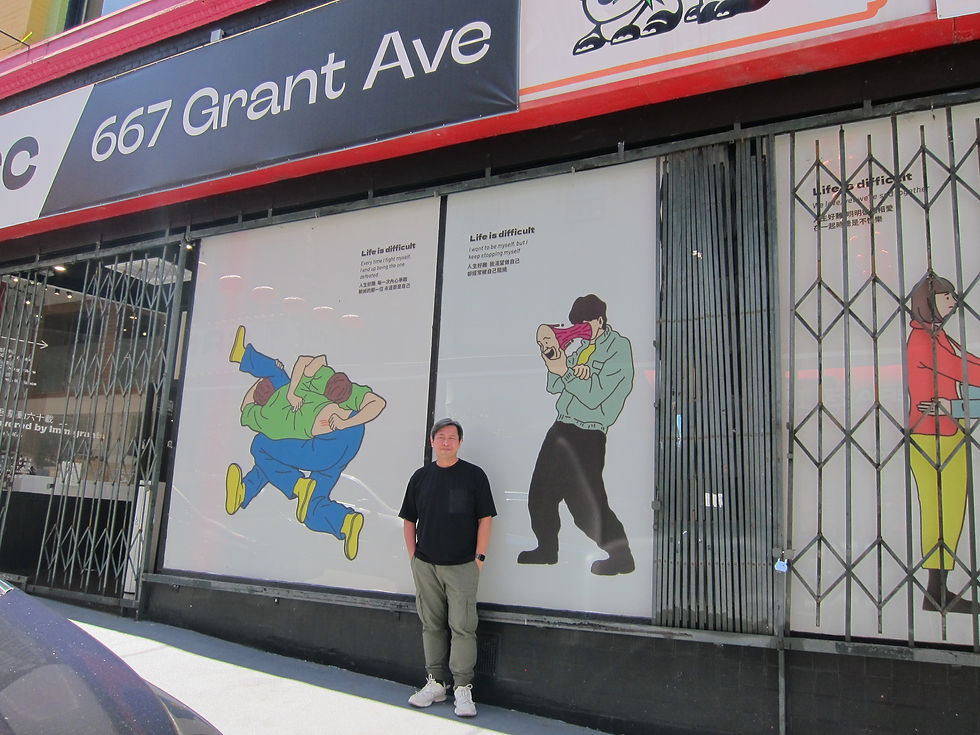
Sophia Callahan April 22, 2026 A few weeks ago we sat down with artist Justin Wong, whose show Carry-On is the inaugural exhibition at the CCC’s 667 Grant Avenue space. In this interview, we speak to him about the role of humor in his work, his dedication to daily practice, and the class he taught at UC Berkeley while he was visiting the Bay Area.
Carry-on is a show about migration, loss, and renewal as it chronicles Wong’s inner worlds through the time in which he left Hong Kong and began to build a new life in London. Through four different series, these works circle the idea of what it means to be a “Hong Konger,” particularly after the implementation of the National Security Law in 2021. Though rooted in a distinctly Hong Kong experience, Wong's work speaks broadly to movement, rupture, and censorship in ways that today feel urgent and recognizable. Carry-on offers insight into how art and humor can act as a salve in our transitional times.
Sophia Callahan is a maker, researcher, and strategist based in the Bay Area. She recently graduated from UC Berkeley’s Masters in Folklore program where Justin Wong was a visiting professor. She was a student in Wong’s course, Laughter as Resistance, Humor, Art, and Everyday Politics in Hong Kong in the Spring of 2026.
Sophia Callahan: Could you talk a little bit about the meaning behind the title of your show, Carry-on?
Justin Wong: Well, ‘carrying on’ is something that I and many others who have left Hong Kong in these last few years have had to do. We left behind the old days, our experience, our roots and we have to face the challenge of settling into a new place. We can't look back to the past—we have to carry on and to continue our journey. That is the thing that we always remind ourselves of: it's a restart.
SC: What is the role of humor in this show?
JW: I've been making comics for almost 20 years now. Humor is something very unique to human beings. You don’t see dogs making jokes, right? Jokes have a way that can make us feel better or make the world a little bit happier—there's magic in humor.
I always use humor in my work. Political cartoons are interesting because on the surface it looks like a joke, but the content is often quite sad. When making comics, I have to deal with these opposite emotions, one that’s making fun and another that can critically look at all these really bad things. That’s our job as a cartoonist: to transform the bad things, the dirty things, the politics, into something funny in order to help people to get through these difficult times.
So that's why I used humor as a theme for this trip, for this show, and for my teaching at UC Berkeley. To be honest, the work in this show is not that funny, but its ‘funny’ can be versatile. There's a contrast between the surface and its content.
SC: Do you have a favorite piece or pieces in the show that really exemplify this?
JW: I like the Life is Difficult series the most, particularly because it's put on such a large scale and people can walk by and see it from the street. The series is really reflecting my current status now that I have left Hong Kong and settled in London. It's been a few years now, but sometimes the emotions of leaving still come back. When they do, I start to ask myself, “Am I okay? Am I settled now?” And then I'll think, “I'm good, I'm fine.” But some emotions come back suddenly and it makes me realize that maybe it's not over yet. Then I think to myself, “Oh, life is so difficult.” But, this ‘difficulty’ doesn't mean I can't deal with it, it just means that’s what it is—it’s difficult.
In life, we encounter a lot of problems, but most of the time, we don't know what the problem is, or we will misinterpret the problems. So, this can lead us to the wrong answer or the wrong solution, because we haven’t found the real problem.
There are difficulties that are hard to describe because they are hidden somewhere in our lives. When I started this series, I started to look for these difficulties that are hard to talk about. I started to look at myself and ask, “So, what are you experiencing? What are you actually experiencing?” It began a self-dialogue.

SC: That’s beautiful. It takes a lot of courage and discernment to look at difficult things that are hidden in plain sight.
JW: It does.
SC: I really like this idea of self-dialoguing as a method to make work. Are there any new projects that you're working on right now?
JW: Yeah, there's one actually. When I arrived in the Bay area in February, the news had just announced that Jimmy Lai went to prison. Jimmy Lai was a Hong Kong media tycoon who ran Apple Daily which was an iconic newspaper to Hong Kong’s democratic movement and he was sentenced to 20 years because of the newspaper. He's almost 80-years-old now, which means we don't know if he will ever come out of prison.
As an artist who creates works for society, the first thing that came to my mind was, “What can I do?” And then I realized that no matter what I do, I can’t really change anything because who am I? I'm such a small potato.
Although the newspaper was controversial sometimes, Jimmy Lai is still an icon. So, I decided I would draw one apple per day for 20 years. Every day I will draw an apple to help me to remember what I still believe. 20 years is scary and in 20 years' time, no one will remember what I have promised to do. But for me, it's different. I've been doing cartoons in the newspaper every day for 18 years, so it made me think that this project could actually be doable.
I created an app to upload the drawing of the daily apple. So, every day when it's posted, I hope it helps people remember who they are and perhaps their values too. I also want to encourage people to start their own 20-year project. It doesn’t have to be an apple, it doesn’t have to be a drawing. Maybe someone writes one sentence per day, or a friend of mine said they would meditate, just the inspiration to do something every day. Habits are how we pass our beliefs on. I know the power of this kind of repetition. It's very mechanical and it is an action that helps me. Without it, I would be lazy or forget. This is a battle of memory. We have to try to remember things.

SC: While you were here, you were a visiting professor in UC Berkeley's Folklore program. You taught a class called Laughter as Resistance, Humor, Art, and Everyday Politics in Hong Kong. What was your process like designing this course? How was it different to previous courses you’ve taught?
JW: It was different because the context of the course was on Hong Kong and the students were not art students. I didn’t know how much the students knew about Hong Kong, so I had to start from the beginning with providing the context of our culture and our heritage.
In the class, I talked a lot about the Lion Rock spirit, which is not just a land rock in Hong Kong, but also a belief and an identity. Lion Rock shows how people from a culture begin to build up their belief and how this belief can be passed on. I also shared the characteristics of Hong Kong people by discussing their unique sense of humor and how that relates to the artwork that's produced there.
This all led us to talk about the protests in the past decades, where we see the real character of Hong Kong people emerge: they're fighting for their rights and at the same time they're making fun and making jokes. We wrapped up the class with a lecture about everyday politics. I introduced the students to Hong Kong artists like Luke Ching and Tozer Pak to show how they use art and politics in their everyday practice to quietly make protests that invites the public to observe the city in a unique way.
SC: Is there anything from this class that you wish you could share with a broader audience beyond UC Berkeley?
JW: Yes, it’s that humor is something that we often ignore or overlook, but it is incredibly important. Particularly for Hong Kong people, because perhaps they don’t know they have this particular humor characteristic. It’s like how I talk about ‘life being difficult,’ one has to understand who they are first, to be able to understand their own hidden difficulties. When we look at humor and resistance, I want to tell Hong Kong people that: “You are a humorous people” and then, maybe, we can use humor even more to help ourselves.
We’re all born with the ability to make jokes. That is really, really helpful. My hope is that Hong Kong people can continue to explore more ways to grow and to tell their story.
SC: As the Hong Kong diaspora has exponentially increased in these last few years, do you think it's changed what it means to be a “Hong Konger" today?
It's a complicated question and the feelings are always changing. There's a struggle between people who stayed in Hong Kong and those who left. We used to be together in one community, but now we're split. Some people who stay in Hong Kong might think, “Enjoy your new life and not bother with Hong Kong anymore” towards those who left. And for those who have left, we might look at people in Hong Kong, and say, “Oh, you should leave.” But for us, it’s hard because there is a serious feeling of loss. We’ve lost our roots and we’re still trying to settle into a new culture.
So, these are conflicts that come up. People we used to be in community with in Hong Kong now see us differently. While, at the same time, in the UK there's an issue of immigration, which brings its own conflict. I’m always thinking, “Oh, am I welcome here?”
Internally, I always ask myself, “Am I still a Hong Konger?” Of course I am, this is an identity that I would never give up. At the same time, I feel like the diaspora is also creating a new definition of what it means to be a Hong Konger.

SC: As immigration continues to be increasingly politicized, how would you describe your experience as living as an immigrant in London now?
JW: When I became an immigrant myself, I realized quickly that I'm a minority, that I’m part of the colored people. It felt strange at the very beginning, but after a while, especially in London, you realize there are a lot of minorities. I am now one of the many people from different cultures that live there.
We [Hong Kongers that immigrated from London] can do it, but we are starting from zero, especially those of us who have moved over the last few years. I can see that we are now starting to make connections and a small community is being formed.
I see this movement as an opportunity to start something new: a new identity, a new community, and a new belief. This gives us the drive to make changes as well, especially as an artist. Artists have a very special position in society: they're not that important, but they can create change in a way other people can’t. So, yes, it's hopeful.
![[SF Chronicle] This historic S.F. neighborhood is now ‘very cool.’ Will a creative resurgence help its recovery?](https://static.wixstatic.com/media/dfd1a1_36c8252e0cf847938b31dc5eaf6c96b1~mv2.webp/v1/fill/w_960,h_640,al_c,q_85,enc_avif,quality_auto/dfd1a1_36c8252e0cf847938b31dc5eaf6c96b1~mv2.webp)
![[KQED] At 60, Chinese Culture Center Enters New Era of Courage](https://static.wixstatic.com/media/dfd1a1_fdaefa04258d4b35b219d9f422ad060d~mv2.jpg/v1/fill/w_980,h_653,al_c,q_85,usm_0.66_1.00_0.01,enc_avif,quality_auto/dfd1a1_fdaefa04258d4b35b219d9f422ad060d~mv2.jpg)
![[7x7] Chinatown’s Hungry Ghost Festival, the only one of its kind in the U.S., returns to San Francisco](https://static.wixstatic.com/media/dfd1a1_b5981015c76940f1a5a627ebf1d5be8e~mv2.jpg/v1/fill/w_980,h_653,al_c,q_85,usm_0.66_1.00_0.01,enc_avif,quality_auto/dfd1a1_b5981015c76940f1a5a627ebf1d5be8e~mv2.jpg)